
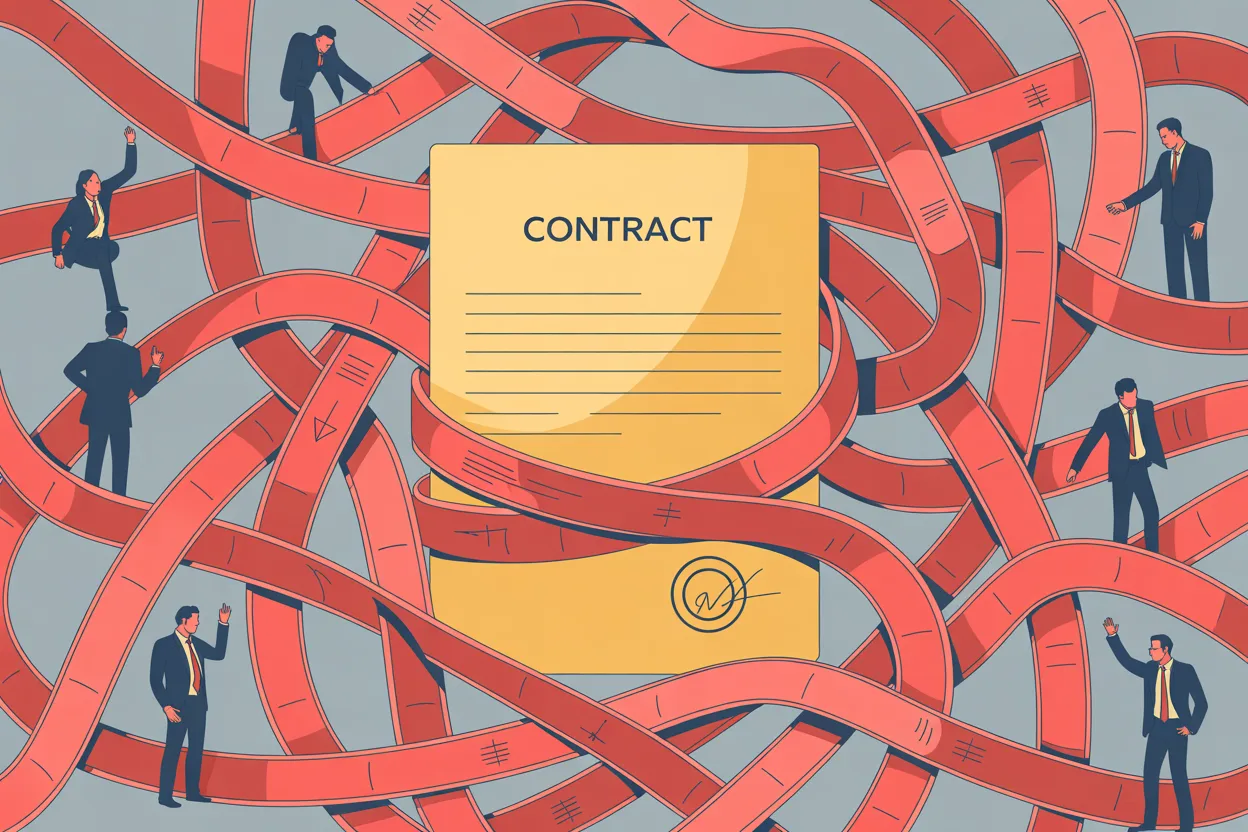
I used to think sales hated legal. Turns out they just hated waiting three weeks for someone to approve a contract that should have taken two days.
The frustration was real and it was specific. A sales rep would send over a new vendor agreement or a customer MSA, and it would disappear into a black hole. They’d follow up. “Where’s my contract?” Legal would say it was in review. A week later, they’d follow up again. “Still in review.” By week three, the rep had either lost the deal or gone around legal entirely, which created a whole different set of problems.
I’ve been on both sides of this. I’ve been the person waiting for approvals and the person the approvals were waiting on. The issue was never that anyone was lazy or incompetent. The issue was that nobody had actually designed the process. Contracts just sort of… moved through the organization the way water moves through a cracked foundation. Slowly, and in directions nobody planned for.
3.4 weeks is the number that should bother you
Forrester and Aberdeen found that the average contract takes 3.4 weeks just to get approved. Not drafted, not negotiated, not signed. Just approved. That’s the internal part, where your own people are supposed to be saying yes.
Think about what that means for a sales team trying to close before quarter-end. Or for procurement trying to get a vendor locked in before a project kicks off. 3.4 weeks of internal delay, and that’s the average. Some contracts take much longer.
When I inherited my current process, the approval chain looked like this: the requesting department would email legal, legal would review and email finance, finance would review and email the department head, the department head would email back with questions, and someone would eventually email the vendor. Every handoff was a chance for the contract to sit in someone’s inbox for three days because they were traveling, or because they didn’t realize it was urgent, or because the email got buried under 47 other messages.
That’s not a process. That’s a relay race where nobody knows when they’re supposed to run.
The two problems nobody solves
Every bad approval workflow I’ve seen has the same two problems.
The first is that every contract goes through the same path regardless of what it actually is. A $500 SaaS subscription gets the same review as a $500,000 MSA. The CEO is approving NDAs. The head of finance is reviewing contracts that don’t have any financial terms worth reviewing. Everyone touches everything, and nothing moves.
The second is that nobody knows where anything is. The contract is “in review” but nobody can tell you whose desk it’s on, how long it’s been there, or what’s needed to move it forward. The requesting team has no visibility. Legal has no visibility. The only person who knows the contract exists is whoever currently has it in their inbox, and they might not even remember it’s there.
These two problems feed each other. When every contract follows the same path, the bottleneck people (usually legal, sometimes finance) get buried. When they get buried, things slow down. When things slow down, nobody has visibility into where the delays actually are. So the answer becomes “we need more people” when the real answer is “we need a better route.”
What I actually built
Here’s what worked for me. It’s not complicated, which is sort of the point.
I set up three approval tiers based on contract type and value.
Tier 1: Standard, low-risk. NDAs, standard vendor agreements under $25K, renewals with no term changes. These need one approver (me or my backup) and should close in 48 hours. If I’m out, it routes to my backup automatically. No other signatures needed.
Tier 2: Moderate complexity. New vendor agreements between $25K and $100K, contracts with non-standard terms, anything involving data processing. These need legal review plus the department head. Two approvers, target turnaround of one week.
Tier 3: High value or high risk. Anything over $100K, contracts with uncapped liability, multi-year commitments, agreements involving regulated data. These get the full chain: legal, finance, and executive sign-off. Target turnaround of two weeks, with an escalation trigger if it stalls.
The thresholds aren’t magic numbers. They’re based on what my organization can tolerate. The point is that a $2,000 NDA doesn’t need the CFO’s signature, and a $300,000 outsourcing agreement doesn’t get approved by one person in 48 hours. Match the scrutiny to the risk.
A 2025 Forrester study found that organizations with structured approval routing reduced ancillary contract turnaround by 40% and complex contract turnaround by up to 50%. That’s not because the reviewers got faster. It’s because the contracts stopped sitting in the wrong queues.
The thing that actually fixed the bottleneck
Tiering helped. But the thing that made the biggest difference was visibility.
I set up a shared board (you could do this in ContractSafe, in Trello, in a shared spreadsheet, it doesn’t matter) where every active contract request sits in one of four columns: Requested, In Review, Pending Signature, Complete. Every entry shows who’s responsible and when it arrived.
That’s it. Four columns and a name.
The impact was immediate. Sales could see their contract was with finance, not stuck in legal. Finance could see they had three contracts waiting and prioritize the urgent one. Department heads stopped sending “where’s my contract?” emails because they could look for themselves. And I could see when something had been sitting in one column for too long and nudge the right person.
SpotDraft’s 2025 benchmarking survey found that contract processing time can drop from 19 days to 3 with automation. I believe it. But you don’t need to automate everything on day one. You just need people to know where things are and who’s responsible. That alone eliminates most of the “sitting in someone’s inbox” problem.
A few things I learned the hard way
Set SLAs and actually enforce them. Each tier has a turnaround target. If a contract sits in someone’s queue past the target, it escalates. Not in a punitive way. Just a nudge: “This has been with you for five days, the target is three, can I help unblock it?” Without SLAs, everything is urgent and nothing is urgent.
Build in an out-of-office plan. I lost a full week on a contract once because the only approver was on vacation and nobody else could sign off. Now every approver has a designated backup, and the routing knows who it is. Sounds obvious. Wasn’t.
Let people self-serve the easy stuff. This was the hardest one for me to accept. I used to review every contract personally, because what if I missed something? But an NDA from a template I approved doesn’t need my eyes on it every time. I set up approved templates in ContractSafe with locked terms, and business teams can generate and send them without legal review. That alone cut my inbound volume by maybe 30%.
Track your cycle times. EY’s Legal Function Reimagined report found that teams tracking stage-specific analytics reduced cycle times by up to 40%, just by seeing where the slowdowns were. I started tracking average time per tier per month. Within a quarter, I could see that finance was the bottleneck on Tier 2 contracts, not legal. So we adjusted the threshold and took finance out of the loop for anything under $50K. Problem solved, and I had the data to justify the change.
It’s not about software
I know this is a blog that occasionally mentions CLM platforms. But the honest truth about approval workflows is that the tool matters less than the design. A bad process in Ironclad is still a bad process. A good process in email is still a good process (though it’ll be harder to maintain).
What matters is: Do you have tiers? Do people know where things are? Is there an escalation path? Can you measure how long each stage takes?
If the answer to those four questions is yes, you have a functional approval workflow. Everything else is optimization.
If the answer to any of those is no, that’s where to start. Not with a software demo. With a whiteboard and the five people who touch contracts most often.
Leave a Reply