
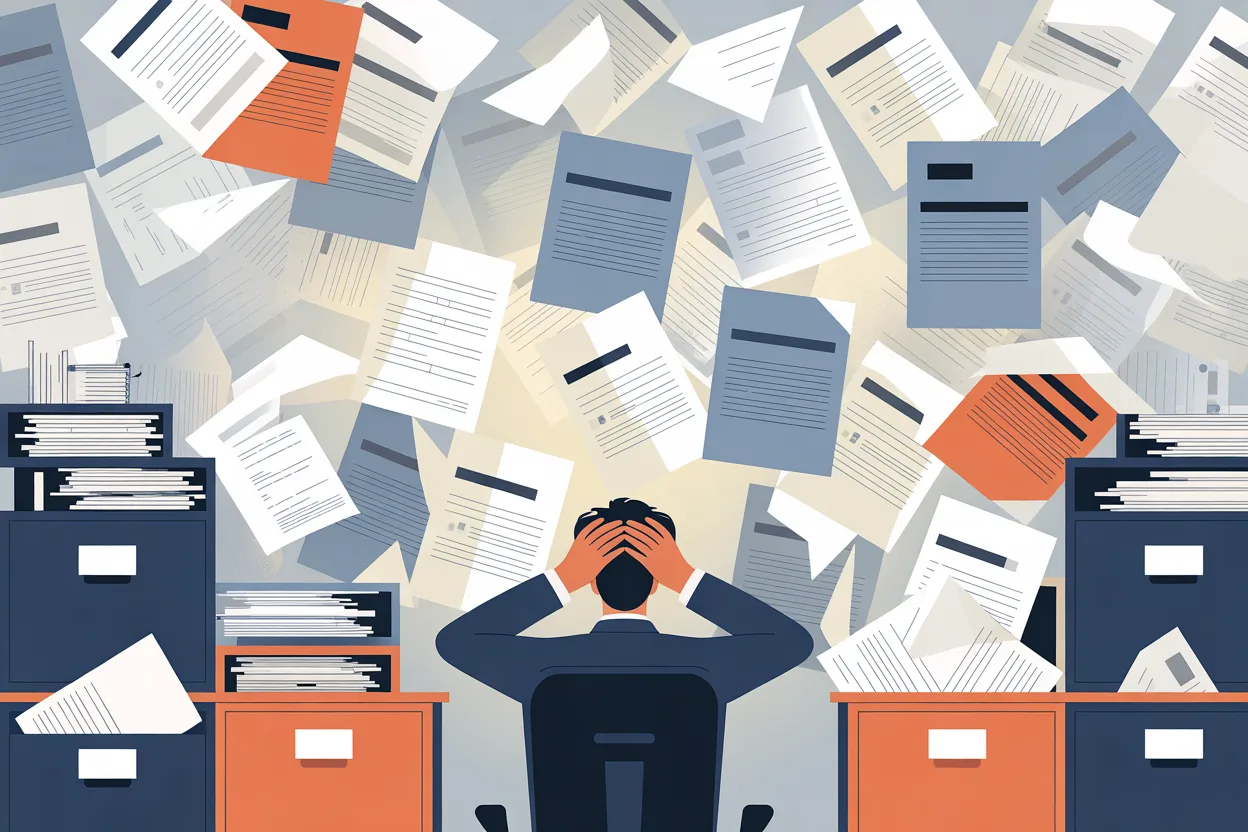
They were scattered across three departments, and not one of them matched the template I’d spent two weeks building with outside counsel. Sales had a version where someone had deleted the non-solicitation clause because a prospect pushed back on it once and the rep figured, why not just take it out? HR had a version with a 36-month term that nobody could explain. And procurement had a version that still referenced a parent company we’d divested from three years earlier.
The worst part: all nine had been sent to counterparties. Some had been signed.
That was the week I stopped letting everyone touch the contract template. Not because I’m a control freak (okay, maybe a little) but because I’d seen what happens when you treat templates like shared documents instead of controlled ones. You end up with a dozen versions of the same agreement, none of them quite right, and nobody sure which one is current.
The template is not a starting suggestion
Here’s the mistake I see over and over again, and I’ve made it myself: you build a template, put it in a shared folder, and tell people to use it. You think you’re done. You’re not. What you’ve done is create a starting draft that people will modify to suit whatever situation they’re in, without understanding what the modifications actually do.
A sales rep takes out the liability cap because the customer’s legal team objected. A project manager adds a payment term that doesn’t match your standard NET-30 policy. Someone rewrites the termination clause because “the old one was confusing.” Each change seems small and reasonable in the moment. None of them go through legal review. And over time, you end up with contracts in the field that your own legal team hasn’t actually approved.
WorldCC’s research found that only 16% of negotiators believe they’re focusing on the right things during contract negotiations. A big part of that disconnect is structural: when templates don’t enforce a baseline, every negotiation starts from a slightly different position. People end up renegotiating terms that were already settled in the template, or worse, accidentally giving away protections that your legal team deliberately included.
What “rogue clauses” actually look like
The industry talks about “rogue clauses” like they’re some dramatic event. In my experience, they’re almost always mundane. A sales rep agrees to unlimited liability because they don’t know what a liability cap is and they want to close the deal. A department head agrees to a six-year auto-renewal because they didn’t read the boilerplate and the vendor’s template made it the default. Someone copies an indemnification clause from a different contract type because “it seemed similar enough.”
I once found a vendor agreement where someone had pasted in an entire intellectual property assignment clause from an employment contract template. The clause would have assigned our IP to the vendor. Nobody had caught it because nobody was comparing the executed contract back to the approved template. It was just another “modified version” in the folder.
None of these things happened because people were reckless. They happened because the template wasn’t controlled and nobody had a clear rule about what could be changed and what couldn’t.
The playbook is more important than the template
After the nine-NDA incident, I built what the industry calls a contract playbook. I hate that name (it sounds like something a consultant would sell you) but the concept is exactly right: it’s a document that tells people what each clause in the template does, which clauses can be modified and within what limits, and when a modification requires legal review.
For example, our NDA playbook says:
The confidentiality term is 24 months. If a counterparty requests 12 months, that’s within the approved range and the business team can agree without escalation. If they request 6 months, that requires legal sign-off. If they want to delete the non-solicitation clause entirely, that’s a hard no unless the GC approves it.
The liability cap is set at the contract value or $1 million, whichever is greater. The business team cannot agree to uncapped liability under any circumstances. Period.
The governing law is our home state. If the counterparty insists on their jurisdiction, legal needs to review it. This is not negotiable at the business level.
This approach does two things. First, it speeds up low-risk deals because the business team has clear authority to make certain concessions without waiting for legal. Second, it prevents high-risk modifications from slipping through because there’s a defined escalation path. NCMA and WorldCC research found that modernizing procurement and contracting practices could reduce transaction costs by as much as 13.3%. A big piece of that is exactly this: getting the routine stuff out of legal’s queue so they can focus on the deals that actually need their attention.
How many templates do you actually need?
One company I worked with had over 40 different contract templates. Forty. For a mid-size professional services firm with maybe six or seven recurring agreement types. What had happened (and this happens everywhere) is that every time a deal had unusual requirements, someone created a “new template” based on the old one. Over five years, the template library had ballooned into something nobody could navigate.
Law firm DWF published a case study about a Fortune 50 pharmaceutical company that had the same problem at enterprise scale. Attorneys across multiple regions had been making independent decisions about clause language, resulting in a total lack of uniformity. DWF helped them cut from roughly 90 templates down to 30, while creating clause libraries and playbooks to handle the variations that had previously spawned entire new templates.
For most organizations I’ve worked with, you need far fewer templates than you think. Here’s my working list:
Master Services Agreement (MSA). Software/SaaS Agreement. Statement of Work (SOW) (paired with the MSA). Non-Disclosure Agreement (NDA), mutual and one-way. Independent Contractor Agreement. Data Processing Addendum (DPA).
That’s six. Seven if you count the one-way NDA separately. Everything else is either a variation that belongs in the playbook (not a separate template) or a one-off that legal should draft from scratch because it doesn’t happen often enough to templatize.
The question I ask when someone requests a new template: “Will we use this more than five times a year?” If the answer is no, it doesn’t need its own template. It needs a lawyer.
Lock the template. Seriously.
After I built the playbook, I did one more thing that made the biggest difference: I locked the templates. Not figuratively. Actually locked them.
In ContractSafe, the templates live in a controlled folder that only I and the GC can edit. When someone needs to start a new contract, they pull the current version. They can fill in the variable fields (party names, dates, dollar amounts, scope descriptions). But they cannot modify the standard clauses without flagging it for review.
Is this annoying for people? A little. Some folks push back because they want the flexibility to make changes on the fly. But here’s what I tell them: the template was built by outside counsel and reviewed by our GC. Every clause is there for a reason. If you want to change one, I’m happy to explain what it does and why it matters. And if there’s a good reason to modify it for a specific deal, we can do that through the playbook process. What we can’t do is let everybody freelance on legal language and hope it works out.
SpotDraft’s benchmarking survey found that 56% of legal teams take a week or more to close standard contracts like NDAs. A week, for an NDA. Part of what’s driving that number is exactly the template chaos I’m describing: when every NDA is a little different because someone modified the template, legal has to review every single one from scratch instead of doing a quick check on the variable fields and moving on.
The template isn’t the boring part
I used to think template management was the boring infrastructure work you do once and forget about. It’s not. It might be the single most useful thing a contracts person can do, and it requires almost no budget.
A good template with a clear playbook means your business team can move faster on routine deals. Legal spends time on complex negotiations instead of reviewing basic NDAs. You stop discovering surprise terms in contracts that have already been signed. And when an auditor asks “how do you ensure consistency across your agreements,” you have an answer that isn’t “we hope for the best.”
Nine versions of the NDA. That was my wake-up call. If you’ve never gone looking for how many versions of your templates are floating around your organization, I’d suggest doing it. You might not like what you find. But at least you’ll know what you’re working with.
Leave a Reply