
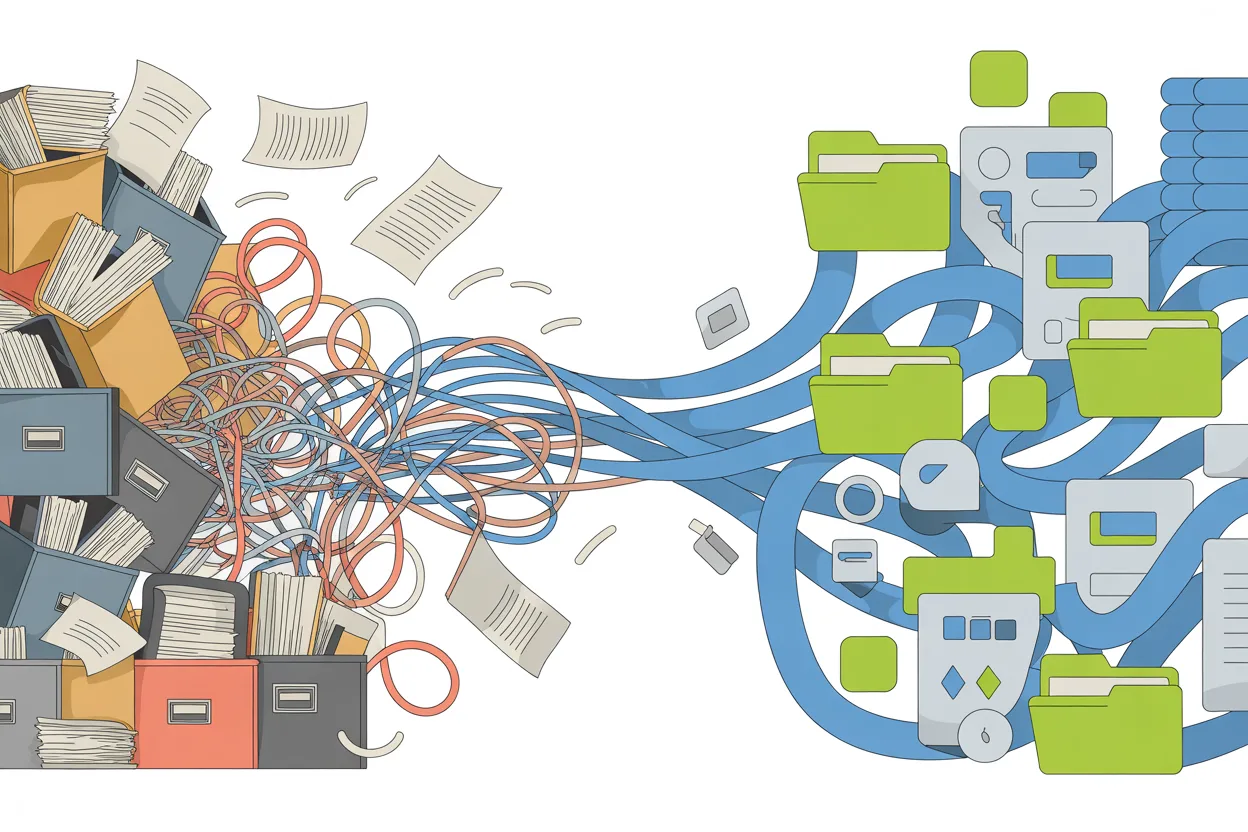
Last year, I sat through a webinar where a vendor described their contract management platform as “an end-to-end digital transformation solution for the modern legal enterprise.” I looked at the demo. It was a searchable database with alerts and some reporting. Which is great. That’s what I use every day. But calling it a “digital transformation solution” is like calling a dishwasher a “kitchen workflow automation platform.” You’re not wrong, technically. But you’re making something simple sound intimidating on purpose.
The contract management industry has a language problem, and “digital transformation” is Exhibit A.
The Most Expensive Phrase in Business
Here’s the thing about “digital transformation” as a concept: it was supposed to describe something real. Companies with deeply embedded legacy processes adopting fundamentally new technology to change how they operate. That’s meaningful. The problem is that the phrase has been stretched so far beyond its original meaning that it now describes everything from a Fortune 500 company rebuilding its entire supply chain on AI to a 40-person company moving its contracts off a shared drive.
Those are not the same thing. But when you wrap them both in the same language, the 40-person company starts thinking they need the same budget, the same timeline, and the same consultants.
The numbers are staggering. IDC projects that global digital transformation investments will reach nearly $4 trillion by 2028, accounting for roughly 70% of all enterprise technology spending. And what’s the return on all that investment? BCG studied 895 digital transformations and found that 70% fell short of their objectives. A 2024 Bain & Company survey of over 400 executives put it even more bluntly: 88% of business transformations fail to achieve their original ambitions. Only 12% deliver what was promised.
Read that again. Trillions of dollars. Twelve percent success rate.
What Most Contract Teams Actually Need
When I talk to people at small and mid-size companies about their contract management situation, nobody says “I need a digital transformation.” They say things like:
“I can’t find anything.”
“We missed a renewal and it cost us $30,000.”
“My boss wants to know how many vendor contracts we have and I honestly don’t know.”
“Everything is in Karen’s email.”
These are real problems. Important problems. But they are not “transformation” problems. They are organization problems. The fix is not a twelve-month change management initiative with a steering committee and a dedicated Chief Transformation Officer. The fix is putting your contracts in one place where people can search them, setting up date alerts so you stop missing renewals, and building a habit of actually using the system.
That’s it. That’s the whole “transformation.”
When I set up ContractSafe at my current org, the entire process took less than a day. I imported the files, the OCR made everything searchable, the system pulled key dates, and I set up automated alerts. By that afternoon, I could find any contract in seconds and I had a renewal calendar that actually worked. Was that a digital transformation? My boss certainly described it that way in a department update. I described it as “I finally got organized.”
Why the Language Matters
I’m not just being pedantic about word choice. The “digital transformation” framing actively hurts the people it’s supposed to help, in three specific ways.
It creates paralysis. When you tell a contracts manager at a 200-person company that they need to “digitally transform” their contract processes, they hear a massive, risky, expensive project. So they do nothing. They keep the spreadsheet. They keep missing renewals. They keep telling themselves they’ll “deal with it next quarter.” The irony is brutal: the fear of the big project prevents the small, simple fix that would actually solve the problem.
It inflates budgets and timelines. The moment you label something a “transformation,” the budget conversation changes. Suddenly you need consultants. You need a phased rollout. You need a pilot program. You need stakeholder alignment workshops. I’ve watched companies spend six months evaluating CLM platforms that they could have set up in a week. The evaluation process cost more in lost time than the software itself.
It sets the wrong success criteria. BCG’s research found that the single biggest driver of transformation failure is misalignment between the initiative and actual business outcomes. When you frame “getting your contracts into a searchable repository” as a “digital transformation,” the success criteria inflate to match the language. Now it’s not enough to find your contracts faster. Now you need to demonstrate ROI across multiple dimensions, prove adoption metrics, and show measurable process improvements on a quarterly dashboard. A project that would have been a clear win as “we organized our contracts” becomes a disappointing underperformance as a “digital transformation.”
The Industry Loves This Word Because It Sells Software
I want to be clear about why this language persists. It’s not because practitioners asked for it. It’s because vendors and consultants benefit from it.
If you’re selling a $200,000 CLM platform, you need the buyer to believe they’re undertaking a transformation. A transformation justifies the price tag. A transformation justifies the 6-month implementation timeline. A transformation justifies the consulting fees for change management, data migration, and stakeholder alignment.
If the buyer understood that what they actually need is a well-organized database with some automation, they’d expect it to cost less and take less time. Which is exactly what happens when you strip the language back to reality.
I’m not saying expensive platforms don’t have their place. Enterprise organizations with thousands of contracts across multiple jurisdictions and complex compliance requirements genuinely need sophisticated tooling. But most of the companies I talk to are not enterprise organizations. They’re teams of 5 to 50 people managing a few hundred contracts and wondering why everything feels so hard. For them, the “digital transformation” framing isn’t aspirational. It’s a barrier.
Meanwhile, the Actual Work Piles Up
Here’s what frustrates me most about this. While the industry debates transformation frameworks and AI roadmaps, CLOC’s 2025 State of the Industry Report found that 83% of legal departments expect demand on their teams to increase. Sixty-three percent said workload and resource bandwidth is their top challenge. These teams don’t have time for transformation. They need solutions that work now.
The same report found that while 30% of legal teams are already using AI and 54% plan to adopt it within two years, many departments remain in the “emerging to developing” stage of operational maturity. Translation: most teams are still trying to get the basics right. They’re not ready for a transformation because they haven’t finished organizing.
And that’s the part nobody wants to say out loud. You can’t transform a process you haven’t documented. You can’t apply AI to contracts you can’t find. You can’t automate workflows that don’t exist yet. The boring work of getting organized has to happen first, and dressing it up as “digital transformation” doesn’t change that. It just makes the boring work sound more expensive.
What I’d Call It Instead
If I ran a CLM company’s marketing department (a job I am profoundly unqualified for, to be clear), I would ban the phrase “digital transformation” from every piece of content, every sales deck, and every webinar title. I’d replace it with something closer to what’s actually happening:
“Get organized.” “Stop losing contracts.” “Know what you’ve agreed to.” “Find things faster.”
These sound small. They sound unglamorous. But they’re honest, and they’re the things that actually improve someone’s workday. Nobody ever left a conference inspired by a keynote on “getting organized,” but getting organized is the thing that would actually help 90% of the people in that audience.
I’ve spent 15 years doing this work, and the single most impactful thing I’ve done at every organization is not a transformation. It’s getting the contracts into one place, making them searchable, and setting up alerts so nothing falls through the cracks. Every time I’ve done that, people’s reaction was the same: “Why didn’t we do this sooner?” The answer, usually, is that they thought it would be harder than it was. Because somebody told them it was a transformation.
Stop Transforming. Start Organizing.
The contract management industry doesn’t need a revolution. It needs to do the basics consistently. Put the contracts somewhere central. Make them searchable. Track the dates. Know what you’ve agreed to. Build from there.
If you want to call that a digital transformation, I can’t stop you. But I’d rather call it what it is: doing the job properly, with the right tools, for the first time. That’s not a transformation. It’s just another day in the trenches …ahem, at the office.
I’m Dave, and I write about contract management the way it actually works. No jargon, no sales pitch, just what I’ve learned from 15+ years of doing this job. New posts every Tuesday and Thursday.
Leave a Reply