
I’ve spent the last fifteen years managing contracts. Not “overseeing the end-to-end optimization of contractual instruments across the enterprise.” Managing contracts. Finding them, reading them, tracking the dates, making sure nobody gets surprised by an auto-renewal or a missed obligation.
And yet, if I go to a conference or read a vendor blog or sit through a sales demo, that simple work gets described like it’s a NASA mission. That’s largely the fault of three words: contract lifecycle management.
I think CLM, as a phrase, has done more harm than good. I know that’s a strong statement. Let me explain.
How a Simple Idea Became an Enterprise Project
At some point (I can’t pin down exactly when, but it tracks with the rise of the CLM software market in the late 2000s), the industry decided that “contract management” wasn’t enough. It needed a modifier. Something that signaled scope and sophistication. “Lifecycle” got the job.
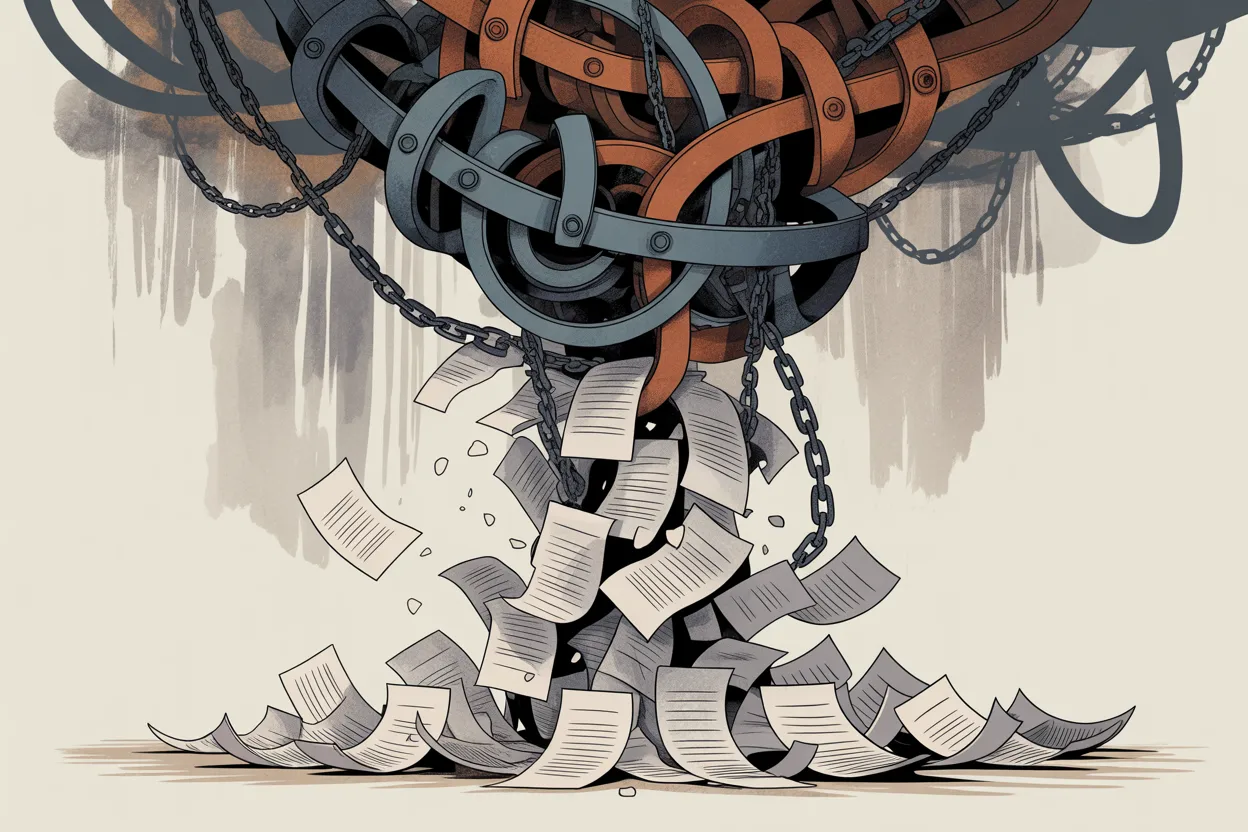
And look, the idea behind it is fine. Contracts have a lifecycle. They get created, negotiated, signed, managed, and eventually renewed or terminated. Describing that arc isn’t wrong. But naming it “Contract Lifecycle Management” and turning it into a branded discipline with certifications, maturity models, and a multi-billion-dollar software market did something subtle and damaging: it made a fundamentally accessible activity sound like something that requires a dedicated platform and a six-month implementation to do properly.
That’s not true. And the data proves it’s not true, because despite all the investment, Gartner estimates that nearly 50% of first-time CLM implementations fail to deliver expected benefits. Juro’s 2024 implementation survey found that 72% of legal teams report their CLM implementation took at least two months, with one in five taking six months or longer. And this is after years of the CLM market growing at 12-13% annually.
Something isn’t working. I think part of what isn’t working is the framing itself.
The Intimidation Problem
Here’s what happens in practice. A company realizes they have a contract problem. Maybe they missed a renewal. Maybe they can’t find a signed agreement during an audit. Maybe someone asks “how many active vendor contracts do we have?” and nobody can answer.
That’s a solvable problem. In many cases, it’s a weekend project. Collect the contracts, put them in one place, log the dates, set up reminders. Done. Not “done perfectly.” But done enough to stop losing money.
Instead, what often happens is this: someone Googles the problem. They land on a vendor’s CLM page. They read about the eight stages of contract lifecycle management. They see the implementation timelines. They see the pricing. And they think: “We’re not ready for this.”
So they do nothing.
I’ve seen this pattern play out at three different companies. The gap between “we know we have a problem” and “we’ve actually done something about it” stretches to months or years because the perceived solution feels too big. The phrase “contract lifecycle management” made the solution sound bigger than the problem.
A startup founder with 50 contracts and a Gmail account full of signed PDFs doesn’t need “CLM.” They need a folder and a spreadsheet with dates in it. But the industry’s language makes them feel like that’s not enough, like anything short of a platform is unprofessional. So they either buy something they don’t need or, more commonly, they do nothing at all.
The Vendor Problem
I want to be fair. The vendors didn’t invent the term out of thin air, and many of them build genuinely useful products. I use ContractSafe every day, and it’s made my job meaningfully easier. The problem isn’t the tools. It’s the way the category got defined.
When “CLM” became the category name, it created a set of expectations. A CLM platform is supposed to handle the entire lifecycle: drafting, negotiation, approval workflows, e-signature, repository, compliance tracking, reporting, renewal management. End to end. The full circle on the diagram.
This is great if you’re a Fortune 500 company with a legal ops team of twelve. For the rest of us? Most of that functionality sits unused. An Onit survey found that the most common factors in failed technology implementations were lengthy processes, overcomplicated solutions, and technology that didn’t fit actual needs. That’s not a technology failure. That’s a category-definition failure. The label promised “lifecycle management,” so the products tried to deliver on all of it, and most users only needed two or three pieces.
What I needed when I walked into that job with 400 contracts across six shared drives wasn’t “lifecycle management.” It was a searchable repository and date alerts. That’s it. That’s what stopped the bleeding. Everything else came later, piece by piece, as the actual needs emerged.
What I’d Call It Instead
If I could rename this discipline, I’d call it something boring. “Contract operations.” Or even just “keeping track of your agreements.” Something that invites people in instead of making them feel like they need a certification first.
The work itself is not complicated. I’m not saying it’s easy (it’s not, especially at scale), but the core activities are things any organized person can do:
Know where your contracts are. Know what dates matter. Know what you’ve agreed to. Pay attention.
That’s the job. You can do it with a filing cabinet. You can do it with a spreadsheet. You can do it with a purpose-built tool. The tool matters less than the habit. And “contract lifecycle management” as a phrase obscures that reality. It makes the tool sound like the prerequisite instead of the accelerator.
The Real Cost
The real cost of the CLM framing isn’t that vendors make money (they should; many of them build good products). The real cost is the companies that never get started because the entry point feels too high.
Juro’s research found that without proper governance, up to 40% of a contract’s value can erode over its lifetime. For a company doing $20 million in contracts annually, even a fraction of that is staggering. And a meaningful portion of that loss could be prevented by someone spending a few days organizing the contracts and setting up a calendar.
But that person reads “contract lifecycle management” and thinks: that’s a project for later, when we have the budget. Meanwhile, the auto-renewals keep rolling, the obligations keep getting missed, and the money keeps leaking.
I talked to a contracts manager last year who told me she’d been trying to get budget for a CLM platform for two years. Two years of proposals and demos and ROI calculations. I asked her what she was doing in the meantime. She said, “mostly putting out fires.” I asked if she’d tried just building a spreadsheet and setting up calendar reminders for the highest-risk contracts. She looked at me like I’d suggested something too simple to possibly work.
It worked. She spent a week on it. She caught two auto-renewals in the first month, saving her company over $60,000. She still doesn’t have a CLM platform. She still wants one. But she’s not losing money while she waits for one.
The Point
I’m not anti-technology. I’m not anti-CLM. I use a contract management tool every day and I’ve written about why it matters and where to start.
What I’m against is language that makes simple things sound hard. “Contract lifecycle management” is a phrase that serves the people selling the solution more than it serves the people doing the work. It turned “keep track of your contracts” into an enterprise initiative. It created a barrier to entry where none needed to exist.
The best contract management is the kind you actually do. Whatever you call it.
I’m Dave, and I write about contract management the way it actually works. No jargon, no sales pitch, just what I’ve learned from 15+ years of doing this job. New posts every Tuesday and Thursday.
Leave a Reply