
Contract Lifecycle Management: What It Actually Means (Without the Sales Pitch)
I have a confession: I find the term “contract lifecycle management” genuinely annoying. I’ll explain why in a separate post, because I’ve got a lot to say about it. But for now, let me do the useful thing and explain what it actually means, because if you’ve been Googling it, you’ve probably been drowning in vendor content that sounds like it was generated by the same marketing team.
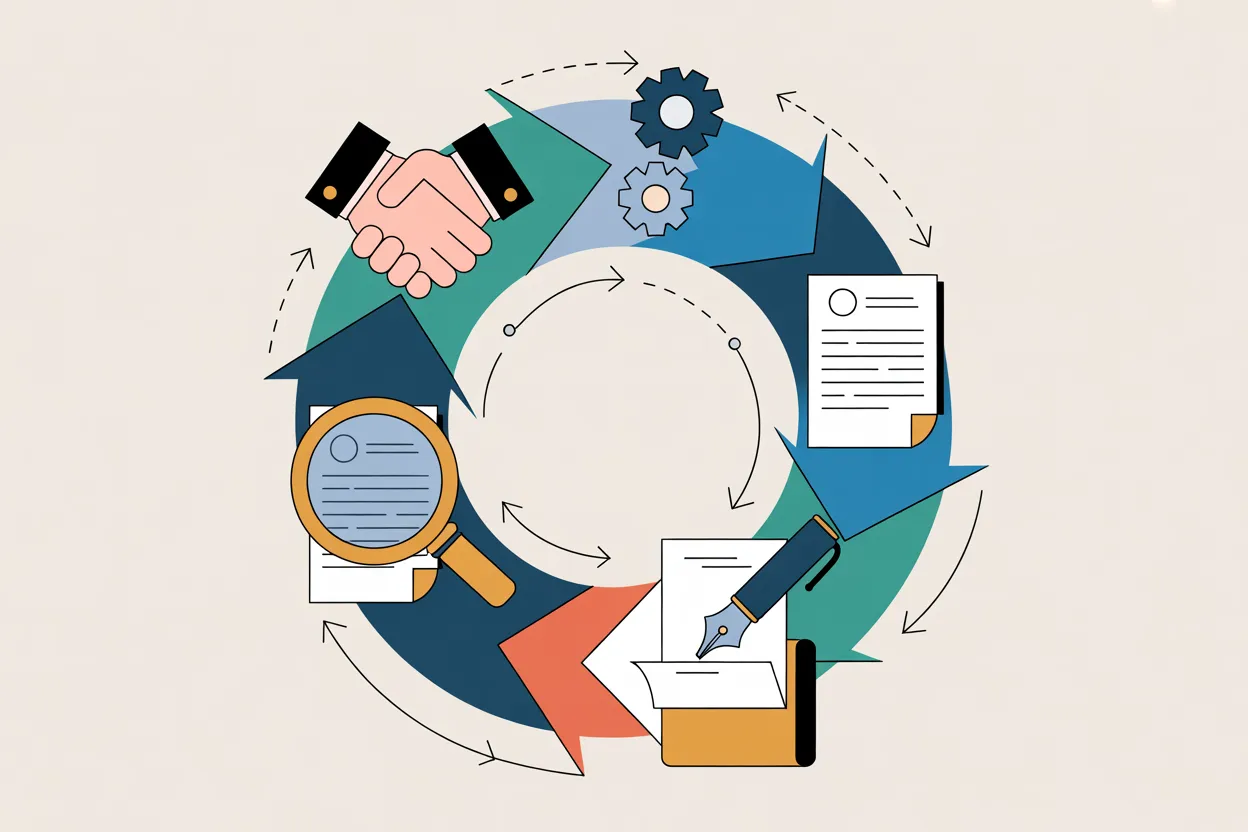
Here’s what you’ll find on most CLM explainer pages: a definition that says something like “the end-to-end process of managing contracts from initiation through execution, compliance, and renewal,” followed by a diagram with five to eight stages in a circle, followed by a pitch for whatever platform the company sells.
Those pages aren’t wrong, exactly. They’re just not written for people who actually do this work. They’re written to rank on Google and move you toward a demo request. I know this because I’ve read about forty of them, and they all say the same things in slightly different fonts.
So let me try something different. Let me explain CLM the way I’d explain it to a new hire sitting across from me on their first day.
It’s Just What Happens to a Contract From Start to Finish
That’s all it is.
A contract gets requested. Someone drafts it. People negotiate terms. Somebody approves it. It gets signed. Then (and this is the part most people forget about) it sits there for months or years, and someone needs to make sure the things it says are actually happening. Eventually it expires, renews, or gets terminated.
That’s the “lifecycle.” It’s not a framework. It’s not a methodology. It’s just a description of what happens. Every contract you’ve ever touched has gone through some version of this, whether or not anyone was deliberately managing it.
The industry took this fairly obvious sequence of events and turned it into a category. “Contract Lifecycle Management” became a thing you buy, not a thing you do. That’s where the confusion starts, and honestly, it’s where a lot of the problems start too. Because once CLM became a product category, the conversation shifted from “how should we handle our contracts?” to “which CLM platform should we buy?” Those are very different questions.
What It Looks Like When Nobody’s Managing It
Before I walk through what CLM looks like when it’s working, let me describe what it looks like when it’s not. Because most organizations live here, and it’s helpful to name it.
Contracts come in through random channels. Email, Slack, a PDF dropped on someone’s desk. There’s no standard request process, so half the time legal doesn’t even know a contract exists until someone asks them to “just take a quick look” at something that was supposed to be signed yesterday.
Drafting is a free-for-all. Everyone has their own version of the template. Someone in sales edited the standard NDA two years ago and nobody caught that they removed the non-solicitation clause. There’s a folder called “Templates” on the shared drive with fourteen files in it, three of which are labeled “CURRENT.”
Negotiation happens in email. Redlines go back and forth as Word attachments. Version control is a fiction. At some point, someone sends the “final” version, which gets three more rounds of changes. Nobody’s sure which version was actually signed.
Post-signature is a black hole. The contract gets signed, maybe filed somewhere, and then forgotten. Nobody tracks the obligations. Nobody monitors the SLAs. Nobody notices the auto-renewal clause until it’s too late. I’ve been doing this for 15 years and the post-signature phase is where I see more money lost than every other stage combined. Not from bad deals, but from good deals nobody bothered to manage once the ink was dry.
If any of this sounds familiar, you’ve got plenty of company. Juro’s research found that 44% of in-house lawyers say getting buy-in for process changes is their biggest challenge. That’s almost half the people who know things are broken telling you they can’t get permission to fix them. The problem isn’t that people don’t see the mess. It’s that fixing it requires organizational will that most companies haven’t mustered yet.
What It Looks Like When Someone Is Managing It
Now here’s the same sequence, but with someone actually paying attention:
Request. A contract need comes in through a defined channel. Could be a form, could be a shared inbox, could be a ticket in your project management tool. The point is that it’s documented and trackable. You know what’s been requested, by whom, and when.
Drafting. You start from an approved template. Not the one Kevin in sales edited. An actual approved template that legal has reviewed. If you need custom language, that’s fine, but you’re building on a foundation that’s been vetted.
Negotiation. Redlines happen, but you know which version is current. There’s a system (even if it’s just a naming convention and a shared folder) for tracking who changed what and when the last round was.
Approval. Before the contract gets signed, the right people review it. For a standard NDA, maybe that’s just one person. For a $500,000 vendor agreement, maybe it goes through legal, finance, and a VP. The key is that someone has thought about who needs to approve what, and there’s a consistent process for it.
Execution. The contract gets signed, ideally electronically so there’s a clear record. The signed version goes into a repository, not into someone’s email archive. Key dates (start, end, renewal, notice periods) get logged.
Post-signature management. This is where the real work is, and it’s where most organizations fall apart. Obligations get tracked. Renewals get flagged well in advance. SLAs get monitored. When something changes (an amendment, a price adjustment, a scope change) the record gets updated.
Renewal or termination. When a contract is approaching its end date, someone makes a deliberate decision: renew, renegotiate, or let it go. Not a panicked scramble with two days left. A deliberate decision.
That’s CLM. It’s not magic. It’s attention applied to a process that most companies let run on autopilot.
You Don’t Need All Eight Stages to Get Started
I want to push back on something the vendor content does that I think is harmful: it presents CLM as an all-or-nothing proposition. Here are our eight stages, here’s our platform that covers all eight stages, here’s the demo button.
Gartner estimates that nearly 50% of first-time CLM implementations fail to deliver expected benefits. And an Onit survey found that 77% of in-house counsels have experienced failed technology implementations, with the top reasons being lengthy processes, overcomplicated solutions, and technology that didn’t fit their actual needs.
Those numbers don’t surprise me at all. I’ve watched it happen. A company decides they need “CLM.” They evaluate platforms for three months. They pick one. Implementation takes six months. By the time it’s live, half the stakeholders have lost interest, the workflows are overengineered, and the people who were supposed to use the system are still emailing contracts to each other because the new tool is too complicated.
The alternative: start with the part that’s hurting you the most. For most companies, that’s one of two things. Either they can’t find their contracts (repository problem) or they keep missing important dates (tracking problem). Pick one. Solve it. Then build from there.
I’ve told this story before, but when I set up ContractSafe at my current org, I had 400+ contracts imported and searchable the same day. That solved the repository problem. Then I set up date alerts for every renewal and expiration. That solved the tracking problem. Everything else, the workflows, the approval routing, the template management, all of that came later. And some of it I still do manually, because at our scale, it doesn’t need to be automated.
The best CLM process is the one people actually use. If that means a simple repository with date alerts and a Monday morning check-in, that’s CLM. You don’t need the eight-stage diagram to get there.
CLM vs. Contract Management: Does the Distinction Matter?
If you read my last post, you might be wondering whether CLM and contract management are different things. Vendors will tell you they are. The typical explanation is that “contract management” focuses on post-signature activities, while “CLM” covers the full lifecycle from creation to termination.
Honestly? I think that distinction is mostly a marketing invention. In practice, if you’re managing contracts well, you’re paying attention to the whole lifecycle. Nobody sits down and says “I’m only going to manage the post-signature part and ignore everything that happened before.” The contract you’re managing is the thing that was created, negotiated, and signed. You can’t separate them.
The real distinction, if there is one, is between reactive and proactive. Reactive contract management is scrambling when something goes wrong. Proactive contract management, whatever you want to call it, means you’ve got a system that keeps you ahead of the deadlines and obligations. That’s the goal. The label you put on it matters a lot less than whether you’re actually doing it.
Where to Go From Here
If you’re new to all this, don’t let the terminology intimidate you. CLM is just a fancy way of saying “know where your contracts are and pay attention to what’s in them.” Start there.
If you’re further along and trying to evaluate whether you need a CLM platform, ask yourself this: what specific problem am I trying to solve? If the answer is “we can’t find our contracts,” you need a repository. If it’s “we keep missing renewals,” you need date tracking and alerts. If it’s “our approval process takes three weeks,” you need a workflow. Match the tool to the problem, not the other way around.
And if someone tries to sell you on “end-to-end CLM” as a single purchase decision, ask them what happens when 50% of those implementations fail. Ask them how long it takes. Ask them what their adoption rate looks like six months after go-live.
Then maybe start with a spreadsheet and work your way up. You’ll be surprised how far that gets you.
I’m Dave, and I write about contract management the way it actually works. No jargon, no sales pitch, just what I’ve learned from 15+ years of doing this job. New posts every Tuesday and Thursday.
Leave a Reply